

Law, Gospel, Both, and Neither
An excerpt of the 2026 WELS Leadership Conference breakout, “Gospel Conversations in the LGBTQ World”
By Ben Dose

Martin Luther once declared that the art of distinguishing law and gospel, and learning when to apply each, was perhaps the highest training a Christian could obtain. Anyone skilled in it, he said, should be considered a first-rate teacher in the church.
Toward this end, CFW Walther laid out a few guidelines toward that end when he asserted that “You are not rightly preaching the Law and Gospel in the Word of God if you preach the Law to those who are already terrified on account of their sins or the Gospel to those living securely in their sins.”
If it is that simple, though, we’re still left with the task of learning to recognize self-security and guilt-riddenness. And that’s anything but simple.
Because sometimes an outward expression of self-confidence and pride is a thin but brightly colored cover, concealing inner anxiety and shame that yearns to belong somewhere safe. What looks like someone “living securely in their sins” is really a hurting soul.
Sometimes penitence is so perfectly practiced and expressed that you miss the legalism behind it—the self-satisfaction of knowing the right words and checking the right boxes. The seemingly self-aware and repentant churchgoer sees no reason to do more than simply show up.
We can’t discount the reality of confusion, either. Sometimes a wrong message was adopted early on and was never corrected, or even tested.
Finally, “The heart is more deceitful than anything. It is beyond cure. Who can understand it?” (Jeremiah 17:9) What we feel one moment may be gone the next. I may start the day in prayer and repentance, welcoming in the renewing Word of grace, and five minutes later need the reality check of the law because I’m already embroiled in a hypothetical argument with my boss. And to the outside observer, I’m just walking to work.
We can take comfort in knowing that “the Word of God is living and active” (Hebrews 4:12), and that even when preached under false pretenses, false understanding, or even just ignorance of who we’re preaching to, the Word can do its work (Philippians 1:15-18). Thank God.
But I don’t think Paul was giving us a cop-out. A safety net, perhaps, but not a guiding star.
How do we do better?
I think we can start by removing some unnecessary barriers.
How do we talk about LGBTQ matters through the lens of the law and gospel?
We’ve heard a lot of suggestions over the years. Here are a few of the most common soundbytes:
Grouped together, these thoughts could be organized in a four-part Venn diagram:
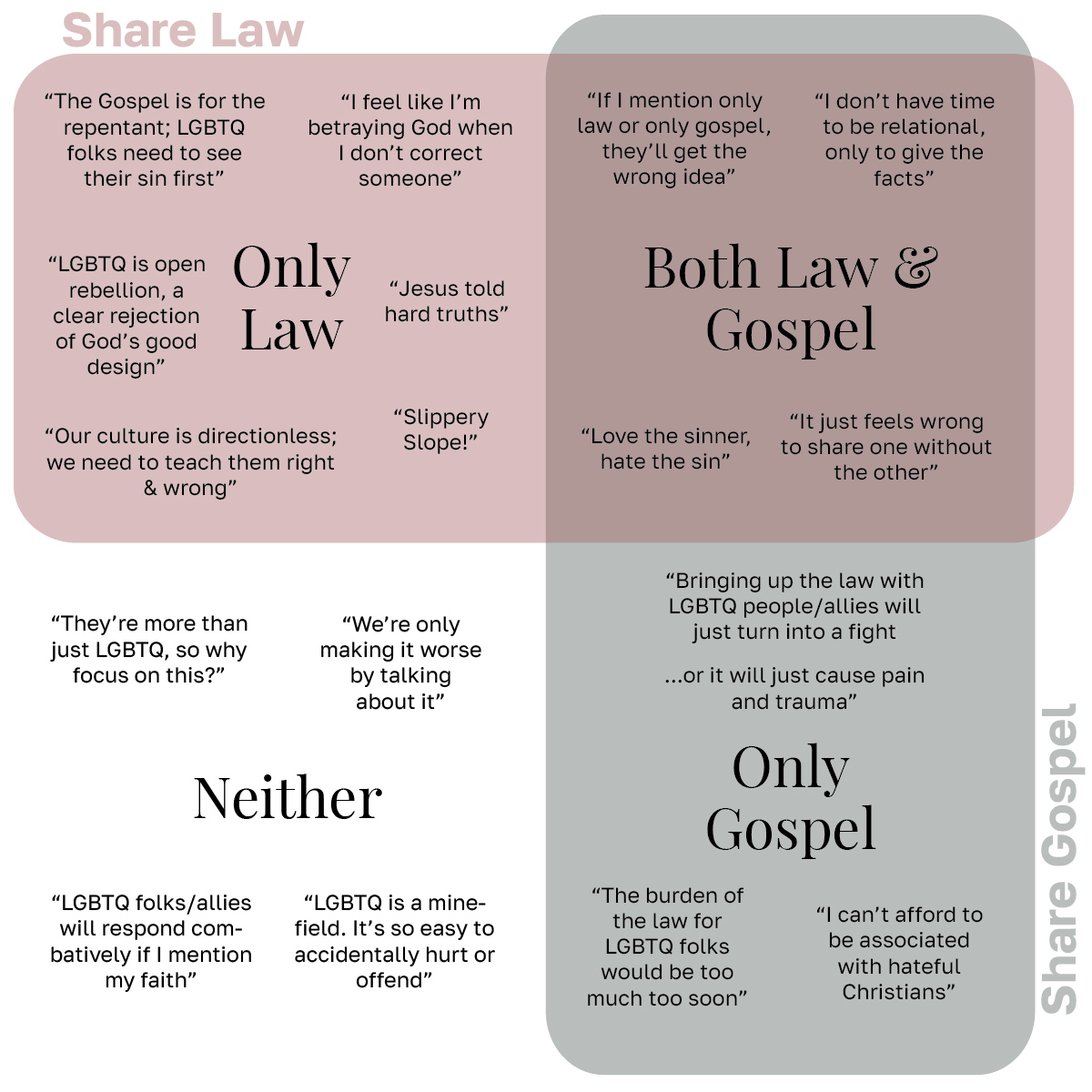
Here’s the thing: not one of these thoughts is categorically wrong or useless. Each one speaks to something very real in the larger conversation on sexuality, gender, and faith. There’s a time and place for all of them.
To put it another way, a frequent question goes something like, “Is _______ a good thing to say in conversations about LGBTQ matters?” For all of the thoughts above, the answer is, “Sometimes.”
But the converse is also true, and that’s the point I’m driving at here: Sometimes we set up unnecessary barriers around LGBTQ matters by believing there’s a one-size-fits-all solution to navigating these conversations. A Law-only approach will not always be the right call, nor a Gospel-only approach, nor Both, nor Neither. As a recent article here put it,
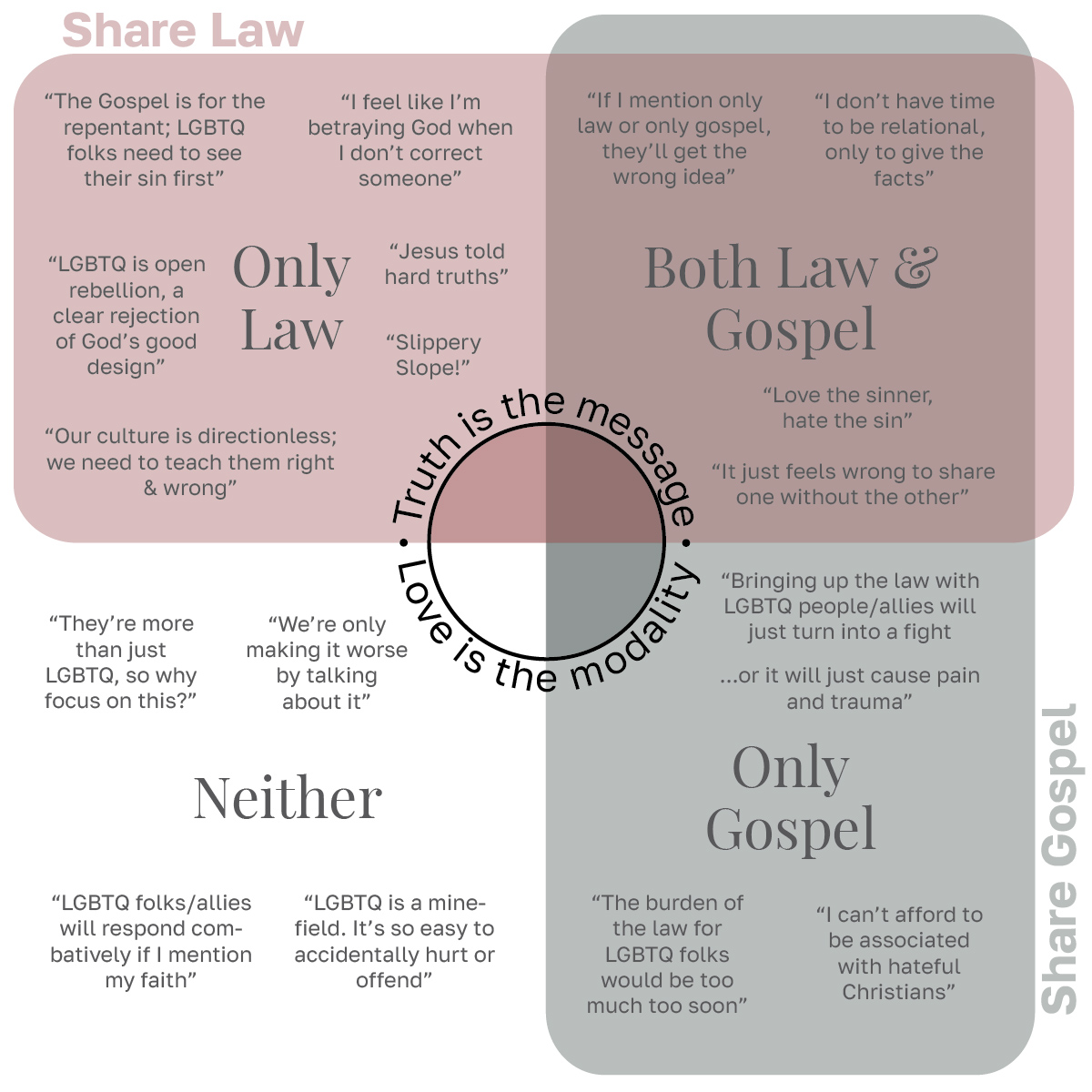
Truth—here, meaning both law and gospel, the “spiritual facts about our existence”—is what we are always working toward in our ministry to others, in word and action. It’s the end goal of our public witness. Love is the modality, the “how,” the mode of operating that guides our tactics and decisions and actions. And it can pull ideas from any of the four quadrants laid out here (and of course there are many, many more good things to say than we’ve shown here).
We return now, though, to one of the challenges posed at the beginning. How do we choose the right thing to say? Because while pictures and diagrams can be helpful in gaining a more holistic view of a question, they also oversimplify. Life isn’t just lines and shapes.
Oftentimes it feels more like this:
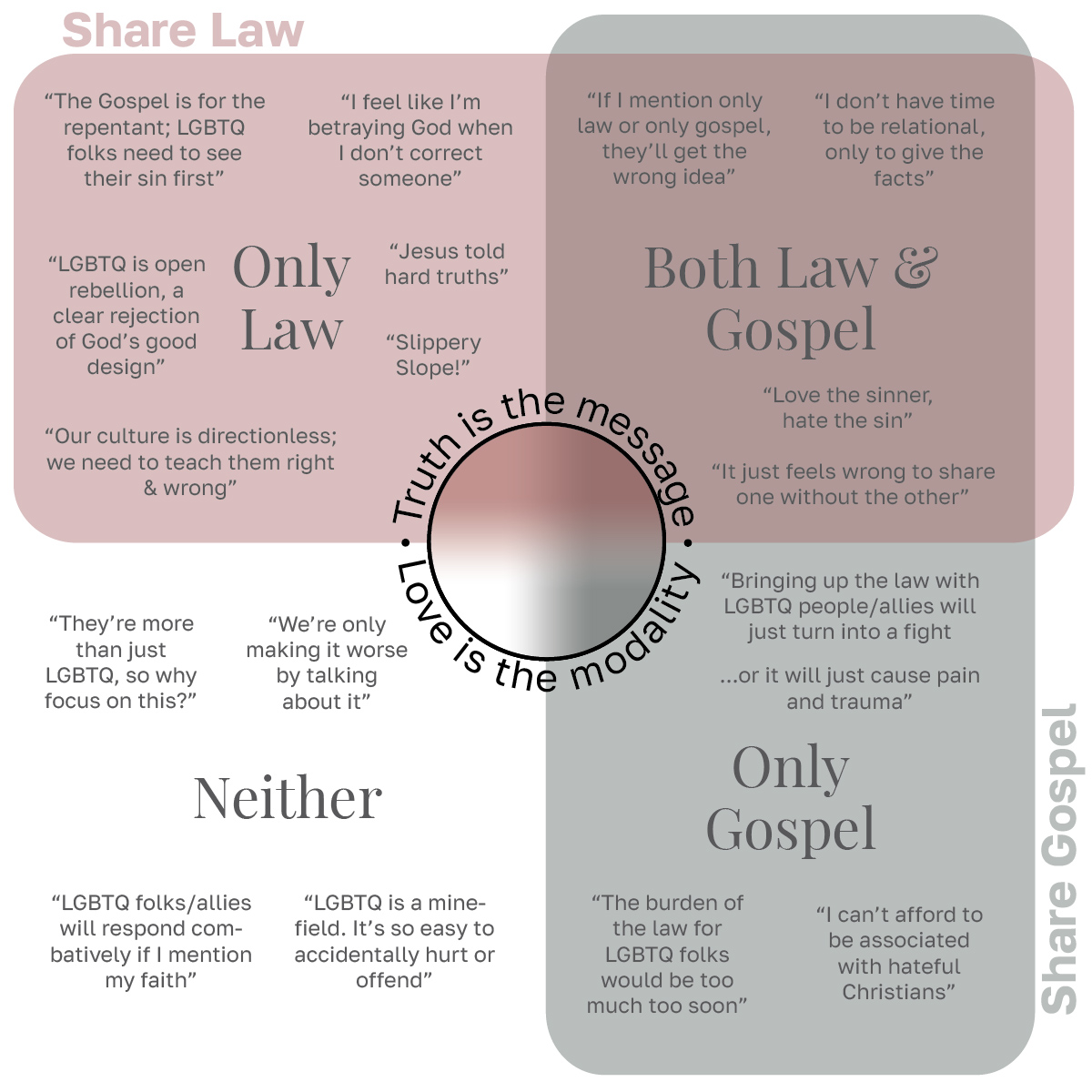
(Note: there’s nothing fuzzy about truth. God is a god of order, not subjectivity. What’s blurry, though, is our ability to perceive truth and distinguish its constituent parts. “Now we see indirectly using a mirror, but then we shall see face to face.” [1 Corithians 13:12])
Sometimes we overcomplicate sharing the truth by setting up unnecessary boundaries. Sometimes we spend too much time in one of the quadrants above, and start to think that that’s the only way to do it. As a result our LGBTQ loved ones start to hear what sounds like a script from us, rather than the whole truth shared in its mosaic of expressions and applications.
Luther was right on the money: The ability to discern the right time, place, and audience for the law and/or gospel is a monumental task. It requires not just biblical wisdom, but keen perception as well—careful patient listening, charity, a willingness to enter into the reality of another, perseverance when the subject matter feels so foreign that you don’t know where to begin, and, more than anything else, genuine love for the soul in front of you.
It’s a lifelong skill, but it’s well worth the effort. And you have a Wonderful Counselor right beside you.
To download a copy of the handout from WNCLL 2026 breakout, click the button below
 https://madeknown.net/wp-content/uploads/2024/06/iconPerspective.png
500
500
B T
https://madeknown.net/wp-content/uploads/2024/06/MadeKnown_LogoHorizontal_White_cropped.png
B T2026-04-23 12:26:042026-04-23 12:26:04Righteousness & Humility
https://madeknown.net/wp-content/uploads/2024/06/iconPerspective.png
500
500
B T
https://madeknown.net/wp-content/uploads/2024/06/MadeKnown_LogoHorizontal_White_cropped.png
B T2026-01-08 11:48:482026-01-08 11:48:48Share All of God
https://madeknown.net/wp-content/uploads/2024/06/iconPerspective.png
500
500
B T
https://madeknown.net/wp-content/uploads/2024/06/MadeKnown_LogoHorizontal_White_cropped.png
B T2025-11-20 11:52:522026-01-08 11:49:14The Things We Overhear, pt. 2
https://madeknown.net/wp-content/uploads/2024/06/iconPerspective.png
500
500
B T
https://madeknown.net/wp-content/uploads/2024/06/MadeKnown_LogoHorizontal_White_cropped.png
B T2026-04-23 12:26:042026-04-23 12:26:04Righteousness & Humility
https://madeknown.net/wp-content/uploads/2024/06/iconPerspective.png
500
500
B T
https://madeknown.net/wp-content/uploads/2024/06/MadeKnown_LogoHorizontal_White_cropped.png
B T2026-01-08 11:48:482026-01-08 11:48:48Share All of God
https://madeknown.net/wp-content/uploads/2024/06/iconPerspective.png
500
500
B T
https://madeknown.net/wp-content/uploads/2024/06/MadeKnown_LogoHorizontal_White_cropped.png
B T2025-11-20 11:52:522026-01-08 11:49:14The Things We Overhear, pt. 2